SOC 2 Type I vs Type II: Which Does Your Startup Need?
SOC 2 Type I vs Type II for startups: which report to pursue first, with cost, timeline, audit difficulty, buyer expectations, and SaaS scenarios.
Based on common SOC 2 audit workflows, startup procurement patterns, auditor documentation, buyer expectations, and compliance automation implementation research.
SOC 2 Type I vs Type II: Which Does Your Startup Need?
For most B2B SaaS startups, the SOC 2 Type I vs Type II decision is not an academic compliance question. It is a revenue timing question.
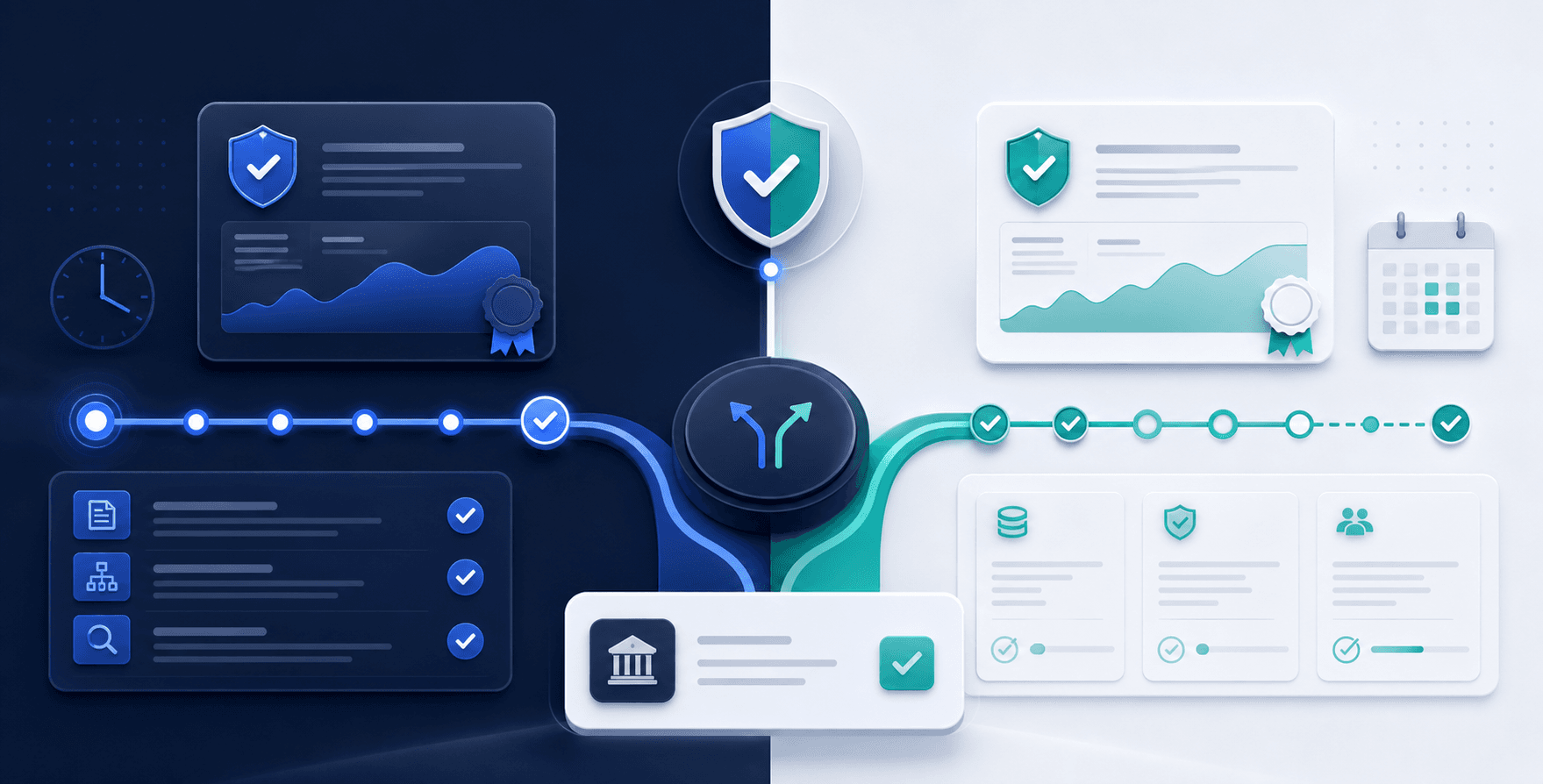
SOC 2 Type I is the faster report when you need proof of control design now. SOC 2 Type II is the stronger report when enterprise buyers need proof that your controls actually operated over time. If a deal is blocked this quarter and the buyer accepts an interim milestone, Type I can help. If you sell to risk-averse enterprise, finance, healthcare, HR, infrastructure, or security teams, a SOC 2 Type II audit is usually the path that closes the procurement loop.
Before choosing a path, run the free SOC 2 readiness checklist. The right answer depends less on definitions and more on your buyer requirement, timeline, budget, evidence maturity, and sales pipeline.
Check readiness before choosing Type I or Type II
Answer a short checklist to see whether your current evidence supports Type I, Type II, or a readiness phase before fieldwork.
This page is the center of our SOC 2 topic authority hub. Use it as the executive decision page, then move into the supporting workstreams:
| Workstream | Why it matters | Next page |
|---|---|---|
| Evidence | Type II depends on historical proof, not policy intent | SOC 2 evidence list |
| Readiness | Prevents buying software or booking audit fieldwork before controls work | SOC 2 readiness checklist |
| Automation | Determines whether Vanta, Drata, Secureframe, or manual audit prep is worth it | SOC 2 automation tools |
| Timeline | Turns SOC 2 into a founder-owned execution plan | 90-day implementation checklist |
| Budget | Keeps audit fees, platform fees, labor, pentesting, and remediation in one model | SOC 2 audit costs |
Quick answer: which should a startup pursue first?
Most startups should choose one of three paths:
| Startup situation | Best first move | Why |
|---|---|---|
| Enterprise deal is blocked and buyer will accept interim proof | Type I first, then start Type II immediately | Fastest way to show progress without pretending Type I is the final destination |
| Buyer explicitly requires Type II | Go straight to Type II if timeline allows | A Type I report may not satisfy procurement |
| No immediate deal blocker, but enterprise sales are coming | Start Type II readiness now | You avoid paying for a Type I report that buyers may outgrow quickly |
| Controls are newly implemented and evidence history does not exist | Type I first | You can validate scope and control design before the observation window |
| Security program already has 3-6 months of clean evidence | Skip Type I and pursue Type II | Type I is not required before Type II |
The practical recommendation: use Type I as a bridge only when it helps unblock revenue. Treat Type II as the long-term commercial asset.
SOC 2 Type II audit: what changes when buyers require operating evidence
A SOC 2 Type II audit is not just a longer Type I audit. It changes the work because the auditor tests whether controls operated during an observation period.
For a SaaS startup, Type II usually means proving that these workflows happened consistently:
| Control area | Type II evidence buyers and auditors usually expect |
|---|---|
| Access control | Scheduled access reviews, MFA enforcement, privileged access approvals, and terminated-user removal |
| Change management | Production changes tied to pull requests, approvals, tests, and deployment records |
| Employee lifecycle | Background checks when applicable, training, policy acknowledgment, onboarding, and offboarding evidence |
| Vendor management | Vendor inventory, critical vendor reviews, SOC 2 reports or security evidence for subprocessors |
| Incident response | Incident process, alert handling, tabletop exercise, or documented incident records |
| Backups and availability | Backup monitoring, restore testing, uptime evidence, and recovery ownership when in scope |
| Monitoring and vulnerability management | Logging, alerting, vulnerability scans, remediation tracking, and exceptions |
If these records do not exist before the Type II period starts, you cannot recreate clean operating history after the fact. That is why the SOC 2 readiness checklist should come before Type II fieldwork.
When Type I is enough vs when Type II is required
| Signal | Type I may be enough temporarily | Type II is likely required |
|---|---|---|
| Buyer requirement | Buyer accepts Type I as interim proof | Buyer explicitly asks for Type II |
| Deal urgency | Contract is blocked this quarter | Procurement timeline allows observation period |
| Evidence history | Controls are newly implemented | Controls have operated for 3+ months |
| Buyer type | Smaller SaaS or mid-market buyer | Enterprise, finance, healthcare, HR, infrastructure, or security-heavy buyer |
| Internal maturity | Policies and owners are still being stabilized | Reviews, offboarding, changes, vendors, and evidence are already recurring |
| Budget | Need the fastest credible milestone | Willing to fund stronger long-term assurance |
Ask the buyer to confirm Type I vs Type II in writing before spending money. If the buyer says "SOC 2 required" but does not specify report type, criteria, auditor expectations, or deadline, clarify those inputs first.
SOC 2 Type I vs Type II comparison
| Category | SOC 2 Type I | SOC 2 Type II |
|---|---|---|
| Business value | Fast proof that controls are designed and implemented | Stronger proof that controls operate consistently |
| Sales use case | Early-stage customer reassurance, interim procurement milestone | Enterprise procurement, annual vendor risk reviews, larger contracts |
| Audit period | Point in time | Period of time, usually 3-12 months |
| Typical timeline | 6-10 weeks if readiness work is mostly complete | 3-12 month observation period plus fieldwork |
| Audit fee only | Often $5,000-$20,000 for small to mid-sized companies | Often $7,000-$50,000, typically 30-50% more than Type I |
| Total first-year budget | Lower, but still includes software, labor, and remediation | Higher because evidence collection and monitoring continue over time |
| Evidence burden | Current policies, configurations, owners, and sample records | Recurring evidence across the observation period |
| Audit difficulty | Moderate if controls are recently cleaned up | Higher because operating consistency is tested |
| Buyer trust | Useful but limited | Gold standard for serious enterprise buyers |
| Best for | Urgent deal support and first audit validation | Durable sales enablement and procurement confidence |
The business difference
Type I answers: Have you designed and implemented the right controls as of the audit date?
Type II answers: Did those controls work consistently during the audit period?
That difference changes the buyer conversation. Type I says, "We have built the security program." Type II says, "We can prove the security program operates."
For a startup, the commercial risk is overestimating how much a Type I report will satisfy buyers. A security-conscious enterprise may accept Type I as a short-term bridge, but many will still ask for a Type II report, a Type II timeline, or a bridge letter showing the observation period has started.
Cost comparison
Audit fees are only one line item. Your actual SOC 2 cost includes auditor fees, compliance software, internal labor, penetration testing, security tooling, and remediation.
| Cost item | Type I expectation | Type II expectation |
|---|---|---|
| Auditor fee | $5K-$20K for many small to mid-sized audits | $7K-$50K depending on scope, period, and auditor |
| Compliance platform | Optional but helpful | More valuable because evidence must be collected continuously |
| Internal labor | Policy cleanup, access review, initial evidence collection | Ongoing evidence validation, exceptions, reviews, and fieldwork support |
| Penetration test | Often requested by buyers or auditors | More commonly expected for enterprise-facing Type II programs |
| Remediation tools | MDM, password manager, vulnerability scanning, logging | Same tools, plus more pressure to keep them working consistently |
| Opportunity cost | Usually lower | Higher; 100-400 hours of engineering, security, HR, and leadership time is common |
Use the SOC 2 cost calculator before you commit to Type I or Type II. Many founders budget for the audit invoice and forget the internal labor tax.
SOC 2 Type II audit cost drivers
Type II usually costs more than Type I because the company pays for a longer evidence process, not just a different report label.
| Cost driver | Why it affects Type II cost |
|---|---|
| Observation period length | Longer periods create more evidence and sample testing |
| Audit firm choice | Boutique, mid-market, national, and Big Four firms price differently |
| Trust Services Criteria | Adding Availability, Confidentiality, Processing Integrity, or Privacy increases scope |
| Number of systems | More production, identity, HR, ticketing, and code systems create more samples |
| Readiness gaps | Missing reviews, policies, monitoring, or vendor files create remediation work |
| Automation platform | Software can reduce evidence work but adds subscription cost |
| Internal ownership | A weak owner creates delay, rework, and hidden labor cost |
For a full budget model, read SOC 2 audit cost 2026. If you need an estimate now, use the free SOC 2 audit cost calculator.
Timeline comparison
The timeline difference is the main reason Type I still exists in startup sales motions.
| Phase | Type I | Type II |
|---|---|---|
| Readiness and scoping | 2-6 weeks if the team is organized | 2-8 weeks, often longer for messy access or policies |
| Evidence collection | Point-in-time evidence plus selected samples | Evidence collected across the observation window |
| Observation period | Not required in the same way | Usually 3-12 months |
| Auditor fieldwork | Often a few weeks | Often a few weeks after the observation period |
| Practical sales timeline | Can help within a quarter | Better planned 6+ months before enterprise procurement pressure |
Be careful with "90 days to Type II" claims. A first Type II report can use a 3-month observation window, but that still means controls must operate for that period. You cannot create six months of access reviews, offboarding evidence, or change approvals after the fact.
Audit difficulty
Type I is not easy, but it is easier to clean up for. Type II is harder because the auditor tests operating effectiveness.
| Control area | Type I difficulty | Type II difficulty |
|---|---|---|
| Access control | Show current MFA, user lists, admin roles, and process | Prove reviews, approvals, and offboarding worked during the period |
| Change management | Show branch protection and sample reviewed changes | Provide sampled production changes with approvals and test evidence |
| Vendor management | Show vendor inventory and current review process | Prove critical vendors were reviewed during the period |
| Employee lifecycle | Show training, policy acknowledgment, device controls | Prove joiner, mover, and leaver controls worked for sampled employees |
| Incident response | Show policy and process | Show alert handling, tabletop exercise, incidents, or monitoring evidence |
| Backups | Show backup configuration | Show restore test and recurring backup evidence |
The usual Type II failure is not a missing policy. It is missing history: no quarterly access review, no timestamped offboarding, no vendor review, no backup restore test, or no evidence that code review happened before deployment.
For the full artifact breakdown, use the SOC 2 evidence list.
Enterprise buyer expectations
Enterprise procurement teams prefer Type II because it gives them stronger assurance and a cleaner vendor risk file. A Type I report can be useful, but many buyers treat it as temporary.
Expect these patterns:
| Buyer type | Likely expectation |
|---|---|
| Mid-market SaaS buyer | Type I may work if deal size is modest and Type II is scheduled |
| Fortune 500 buyer | Type II is usually expected |
| Healthcare or fintech buyer | Type II plus tighter vendor, privacy, and availability questions |
| HR tech buyer | Type II is strongly preferred because employee data and offboarding matter |
| Infrastructure or developer tooling buyer | Type II plus deep technical evidence questions |
| EU enterprise buyer | Type II may be required, with extra scrutiny around data residency and subprocessors |
If a buyer says "SOC 2 required," ask four questions before spending money:
- Do you require Type I or Type II?
- Which Trust Services Criteria are required?
- Will you accept a Type I report plus Type II bridge letter?
- Does the auditor need to be a national firm, Big Four, or specific approved CPA firm?
The cheapest audit is expensive if the report is rejected by the customer that triggered the project.
Choosing a SOC 2 auditor for Type II
Type II audit success depends heavily on auditor fit. The cheapest auditor is not always the cheapest path if they do not understand your stack, your GRC platform, or your buyer deadline.
Before selecting an audit firm, confirm:
- whether they are a licensed CPA firm authorized to issue SOC 2 reports
- how many Type II audits they have completed for SaaS companies like yours
- whether they work cleanly inside your GRC platform or evidence tracker
- what evidence usually delays startups in your stage
- what creates change orders
- who will actually run fieldwork after the sales process
- whether target customers will accept the report
For the full selection framework, read Best SOC 2 audit firms for startups.
When ISO 27001 enters the roadmap
SOC 2 and ISO 27001 often enter the same buying conversation, but they should not automatically start at the same time.
SOC 2 is usually the first commercial blocker for US-focused B2B SaaS startups. ISO 27001 becomes more relevant when EU or global enterprise buyers ask for a formal information security management system, when procurement teams explicitly request ISO certification, or when the company wants one control program that supports multiple frameworks.
| Situation | Practical move |
|---|---|
| One US enterprise buyer asks for SOC 2 Type II | Focus on SOC 2 readiness and Type II evidence first |
| EU or global buyers ask for ISO 27001 | Ask vendors how SOC 2 controls map into ISO 27001 before signing |
| The company has no recurring control owner | Do not add ISO yet; stabilize SOC 2 operations first |
| SOC 2 evidence is already operating well | Consider ISO 27001 planning as the next framework layer |
| The software quote charges heavily for add-on frameworks | Model the total cost before buying a multi-framework package |
The right order is usually: buyer requirement, SOC 2 report path, readiness, evidence ownership, then ISO expansion. Do not let a platform demo turn an urgent SOC 2 project into an unfunded multi-framework program.
Startup readiness: how to decide before buying software
Use readiness, not optimism, to choose the report.
| Readiness signal | Type I first | Type II direct |
|---|---|---|
| MFA and identity | Recently enabled | Enforced and monitored for months |
| Access reviews | First review just completed | Reviews happen on schedule with evidence |
| Offboarding | Process exists but history is inconsistent | Terminations have timestamped access removal |
| Change management | Branch protection and review process just cleaned up | PR reviews and deployments are consistently traceable |
| Vendor management | Inventory exists, reviews still light | Critical vendor reviews are documented |
| Policies | Recently written or revised | Policies match operating reality and are acknowledged |
| Internal owner | Founder or CTO is learning the process | Named owner manages evidence and exceptions |
If you score weakly on several of these, do not rush into Type II fieldwork. Start remediation, collect evidence, and consider Type I only if it supports a near-term commercial need.
Real-world SaaS scenarios
Scenario 1: Seed startup with one enterprise buyer
A 15-person SaaS company has one six-figure deal blocked by a security questionnaire. The buyer says SOC 2 is required but will accept Type I if Type II is already planned.
Best move: Type I first, with a written Type II timeline. Use Vanta, Secureframe, or a focused auditor-led readiness process if the team needs speed and structure.
Why: The company probably does not have enough operating history for Type II, but it can show control design and start the Type II observation window immediately.
Scenario 2: Series A SaaS selling into healthcare
A 60-person healthtech company has multiple prospects asking for SOC 2 Type II, HIPAA posture, vendor risk answers, and stronger evidence around employee access.
Best move: Type II direct if evidence history exists; otherwise start readiness immediately and avoid overselling Type I.
Why: Healthcare buyers are less likely to treat Type I as enough. Secureframe may be worth evaluating for guided multi-framework support; Drata may fit if the team has a technical security owner.
Scenario 3: Developer tool with complex infrastructure
A 40-person infrastructure startup uses AWS, Kubernetes, GitHub, Terraform, and custom internal tooling. Buyers ask hard questions about production access and change management.
Best move: Type II direct if controls are already operating; otherwise run a short readiness phase before committing.
Why: The buyer risk team will care more about access, logging, change control, and incident evidence than a clean policy packet. Drata may be a better fit if custom control mapping matters; Vanta may be faster if the stack matches its integrations.
Scenario 4: Bootstrapped five-person startup
A small team has no signed enterprise pipeline but is thinking about SOC 2 for credibility.
Best move: Do not buy a full platform yet. Use a readiness checklist, clean up basic security, and wait for a real buyer signal.
Why: Spending $10K+ on software plus audit fees before there is a revenue reason can be a poor use of runway.
Vanta vs Drata vs Secureframe for Type I and Type II
Compliance software is not mandatory, but it can reduce the evidence scramble. The tool choice should follow your report path.
| Platform | Better fit | Why it matters for Type I vs Type II |
|---|---|---|
| Vanta | Seed to growth SaaS startups with mainstream cloud tools and sales urgency | Broad integrations and auditor familiarity can make a first Type I or Type II path faster |
| Drata | Engineering-led teams with a dedicated security owner and custom controls | Stronger fit when Type II evidence needs deeper control mapping and API-driven workflows |
| Secureframe | Teams needing guided implementation, policy support, or regulated-framework help | Useful when the team lacks a GRC hire and needs help avoiding readiness mistakes |
Before booking demos, use the SOC 2 vendor comparison tool. Then pressure-test vendor claims with these questions:
- How much Type II evidence will your platform collect automatically for our actual stack?
- Which controls will still require manual evidence?
- Can our auditor work directly in the platform?
- What happens if we switch platforms during a Type II observation period?
- Are Trust Center, vendor risk, and questionnaire automation included or add-ons?
- What is the year-two renewal cap?
For deeper vendor due diligence, read Vanta pricing, Vanta vs Drata, Vanta vs Secureframe, and best SOC 2 vendors.
Affiliate note: we may earn commissions from qualified referrals or partner links. Our recommendation is based on startup stage, buyer pressure, audit path, and operating fit.
Common mistakes
| Mistake | Why it hurts | Better decision |
|---|---|---|
| Assuming Type I is required before Type II | It is not required, and it can add cost if buyers only care about Type II | Skip Type I when you have evidence history and no urgent interim buyer need |
| Treating Type I as "done" | Buyers may ask for Type II anyway | Use Type I as a bridge with a Type II date |
| Starting Type II before controls operate | Missing evidence can create exceptions or delay the report | Start readiness first and collect evidence before the observation window |
| Buying software before scoping the audit | You may overbuy frameworks, modules, or support | Confirm buyer requirements and scope first |
| Choosing the cheapest auditor | Enterprise buyers may question low-quality reports | Match auditor credibility to customer expectations |
| Switching platforms during Type II | Evidence continuity can break | Migrate between audit cycles when possible |
| Copying policy templates | Auditors test whether you follow the policy | Write policies that match actual operations |
Decision framework
Use this sequence from a SaaS founder, CTO, and compliance lead perspective:
- Ask the buyer whether Type I or Type II is required.
- Confirm Trust Services Criteria and auditor expectations.
- Run the SOC 2 readiness checklist.
- Estimate total budget with the SOC 2 cost calculator.
- Choose Type I only if it unblocks a real deal or validates new controls.
- Start Type II evidence collection as soon as the control environment is stable.
- Choose Vanta, Drata, Secureframe, or a manual path based on evidence workload and internal ownership.
How each stakeholder should read the decision
| Stakeholder | Primary question | Practical implication |
|---|---|---|
| Founder / CEO | Will this satisfy the buyer fast enough to protect pipeline? | Do not buy a report that the target customer will reject. Get written confirmation on Type I vs Type II acceptance. |
| CTO / Head of Engineering | Can we prove controls operated without slowing product delivery? | Focus on access, change management, cloud configuration, incident response, and evidence automation before fieldwork. |
| Compliance lead / Operations | Can we maintain evidence through audit and renewal? | Assign owners, define cadence, track exceptions, and avoid policies that do not match actual operations. |
| Finance / RevOps | Is this spend attached to real revenue or strategic market access? | Model audit fees, software, internal hours, pentesting, remediation, and renewal costs together. |
The high-converting path is not a generic "SOC 2 guide." It is a connected buying journey: Type I vs Type II decision, readiness score, evidence list, implementation timeline, vendor shortlist, and auditor selection.
People Also Ask
Is SOC 2 Type I enough for startups?
SOC 2 Type I can be enough for an early-stage startup if the buyer accepts it as interim proof and the company has a clear Type II roadmap. It is less likely to satisfy large enterprise, healthcare, fintech, HR, or infrastructure buyers that expect operating evidence.
Should a startup skip Type I and go straight to Type II?
Yes, if the startup already has several months of clean evidence and no urgent customer need for an interim Type I report. Type I is not a prerequisite for Type II.
How much more expensive is SOC 2 Type II than Type I?
Audit fees for Type II are often 30-50% higher than Type I because the auditor tests operating effectiveness over time. The larger cost difference is internal effort: Type II requires ongoing evidence collection, access reviews, offboarding proof, change samples, vendor reviews, and exception handling.
How long does SOC 2 Type II take?
A first SOC 2 Type II report typically requires a 3-12 month observation period plus readiness work and auditor fieldwork. A 3-month Type II is possible, but the controls must actually operate during that period.
Is SOC 2 Type I required before Type II?
No. SOC 2 Type I is not required before Type II. A startup can go directly to Type II if controls are mature enough and enough operating evidence exists for the observation period.
What should startups do before starting Type II fieldwork?
Start with readiness, not fieldwork. Confirm buyer requirements, assign control owners, run access reviews, clean up offboarding, collect vendor evidence, test backup and incident workflows, estimate budget, and choose an auditor that understands your stack.
Do enterprise buyers accept SOC 2 Type I?
Some do, especially as a temporary measure. Many enterprise buyers still ask for Type II, a bridge letter, or proof that the Type II observation period has started.
Bottom line
If SOC 2 is blocking a live deal and the buyer accepts Type I, pursue Type I quickly and start Type II monitoring immediately. If your buyers are enterprise risk teams, regulated industries, or security-heavy customers, plan for Type II from the beginning.
The strongest startup path is not "Type I vs Type II" in isolation. It is matching the report to the buyer requirement, proving readiness before fieldwork, and building an evidence process that can survive renewals.
Free SOC 2 tool
Not sure what to do next?
Use the free soc 2 readiness checklist tool for saas startups to get an instant result before booking vendor demos or audit calls.
Related Articles